May 13, 2026
Application Stabilization: From System Crisis to Operational Control
By Rusty Davis
3 AM pages. Rollbacks that don't hold. A team that's exhausted and losing faith. If your system is actively in crisis, incremental improvement isn't enough. You need a focused stabilization engagement. Here's what that looks like and what it delivers.
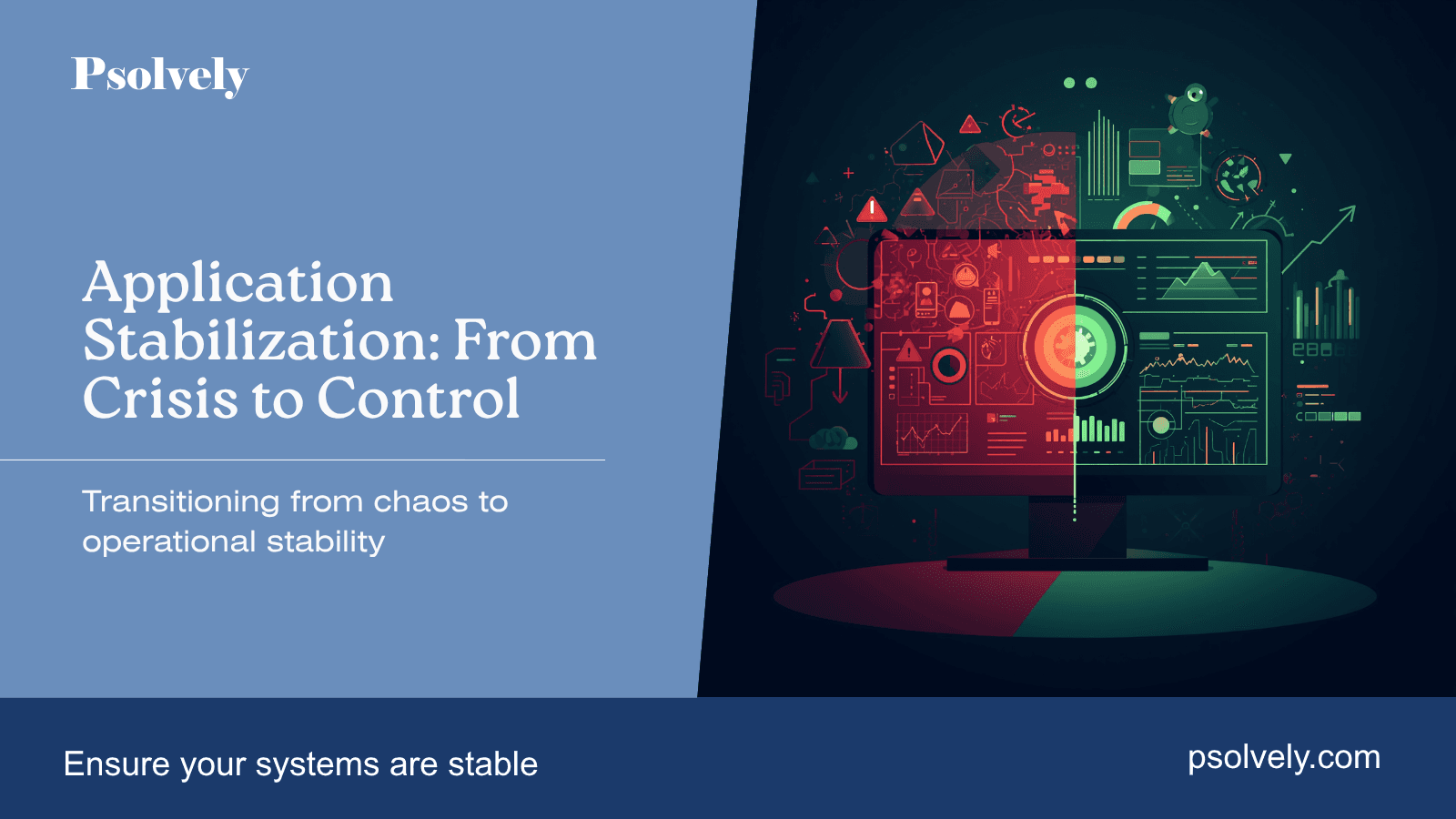
Application Stabilization: From System Crisis to Operational Control
You know the state I'm talking about.
The 3 AM page that wakes you up for the third time this week. The rollback that takes 45 minutes because the deployment pipeline is fragile and everyone's afraid to move fast. The incident that "should be fixed" from last Tuesday resurfacing in a slightly different form at 2 PM on Friday. The on-call rotation that's becoming a retention problem because your best engineers are burning out.
Your team is not incompetent. They're overwhelmed, understaffed for the problem they're dealing with, and too close to the system to see it clearly anymore. They've been in firefighting mode so long that firefighting has become the job.
This is what a system in crisis looks like from the inside. And if you're reading this, you're probably there, or you can see it coming.
Let's talk about what actually fixes it.
Why Internal Teams Usually Can't Stabilize Alone
The first thing leadership usually tries is throwing more internal resources at the problem. Pull engineers off roadmap work. Dedicate a task force. Work the weekends.
This sometimes helps for a few weeks. It rarely holds.
They're too close to the system. Engineers who've been living in a codebase for months or years develop powerful intuitions about it. Those intuitions can be wrong in systematic ways. They've learned to work around the fragile parts. An outside perspective is genuinely valuable here, not as a criticism of the team, but because fresh eyes find things that familiarity obscures.
They're context-switching constantly. The engineers closest to the problem are also the ones fielding questions, running incident retrospectives, joining the 3 AM calls, and keeping the rest of the business informed. Sustained stabilization work requires focus. Crisis mode makes focus impossible.
They don't have enough people for the problem. Most engineering teams are sized for normal operations, not simultaneous stabilization and maintenance. When the system goes into crisis, the work required exceeds what the team can deliver. Asking the team to work harder doesn't create more capacity. It creates burnout.
The system has accumulated risk that requires structured analysis to unwind. Crisis systems almost always have the same profile: years of patches stacked on patches, fragile dependencies, monitoring insufficient to catch problems before they become incidents.
This is the gap a stabilization engagement fills.
What a Real Stabilization Engagement Looks Like
A stabilization engagement is a focused, time-boxed engagement with a specific objective: get the system from crisis to stable operations, with a clear handoff at the end.
Phase 1: Discovery and Triage (Weeks 1-2)
Review incident history — not just the last two weeks, but the last 6-12 months. What are the recurring failure modes? What do incidents have in common?
Review the architecture and codebase with fresh eyes. Where are the fragile dependencies? What's the blast radius if the most critical component fails? What's the current state of monitoring?
Talk to the team. Not just engineering leads, the engineers who are actually on-call, who know which parts of the system they're afraid of and why. They know where the trouble spots are and what makes them potential future problems.
Output: Written risk assessment, prioritized stabilization backlog, team alignment on what gets addressed and in what order.
Phase 2: Prioritization and Quick Wins (Weeks 2-4)
The prioritization framework looks at two dimensions: likelihood of failure and impact of failure. Work on the highest-likelihood, highest-impact problems first.
In most crisis systems, 3-5 changes will disproportionately reduce incident rate. Common quick wins:
- Adding or fixing monitoring and alerting so you know about problems before users do
- Fixing a deployment pipeline that's slow, unreliable, or requires manual intervention
- Addressing the single highest-failure-rate component responsible for most incidents
- Cleaning up the rollback process so recovery is fast and reliable when something does go wrong
Quick wins matter for morale as much as for the system. Engineers in firefighting mode for months need to see evidence that the situation is changing.
Output: Monitoring improved, deployment pipeline more reliable, top 3 incident sources addressed. Incident rate measurably lower than at engagement start.
Phase 3: Core Stabilization Work (Weeks 4-8)
With quick wins in place and immediate risk reduced, Phase 3 addresses the structural issues driving instability. This typically includes:
- Architectural changes to isolate fragile components and reduce blast radius
- Dependency upgrades deferred because they felt risky
- Test coverage in the highest-risk areas
- Runbook creation for the most common failure modes
- Load testing and capacity planning if the system has been hitting resource limits
The goal is not perfection. The goal is a system that's operationally manageable. Where failures are caught before they become incidents. Where the team knows how to respond when something does go wrong.
Output: Documented runbooks, reduced blast radius for highest-risk components, measurably improved stability metrics.
Phase 4: Handoff (Final 1-2 weeks)
A stabilization engagement that doesn't hand off cleanly hasn't done its job. The last phase is about transferring knowledge and ownership back to the internal team.
Documentation, not just architectural docs, but decision logs explaining why specific choices were made. Runbooks that are actually usable under pressure. A clear picture of what was stabilized and what still carries risk.
Output: Complete documentation, knowledge transfer done, internal team owns the system with full context.
Measurable Outcomes You Should Expect
Before you start, agree on the metrics you'll use to assess success:
- Incident rate: P1/P2 incidents per week at engagement start vs. end
- Mean time to resolution: How long to resolve incidents?
- Deployment frequency: How often can you deploy without fear?
- Deployment success rate: What percentage complete without rollback?
- On-call burden: How many pages per week is the on-call engineer handling?
Set baseline measurements in Week 1 and track them throughout. If the metrics aren't moving in the right direction, the engagement should self-correct. You should know whether it's working before the final week.
Who This Is For
If your system is in active crisis, meaning you have multiple incidents per week, rollbacks that don't hold, a team that's exhausted, you need a stabilization engagement, not incremental improvement. Incremental improvement assumes you have the capacity to make steady progress. Crisis mode means you don't.
If you're not in active crisis but you can see it coming with the incident rate increasing, the team nervous, the foundation getting shakier, then a stabilization engagement now is significantly less expensive than one in six months when the situation has deteriorated further.
Book a Free Call
This is exactly the work Psolvely does. Our stabilization sprint is a 4-8 week engagement designed to take your system from crisis to operational control, with measurable outcomes and a clean handoff.
If you're in crisis right now, don't wait. The longer a system operates in crisis mode, the more embedded the instability becomes, and the more expensive it gets to fix.
Book a free call at psolvely.com. We'll spend 45 minutes understanding your situation and tell you honestly whether a stabilization sprint is the right fit.
Want to work together?
Book a 45-minute strategy session and leave with a concrete plan.
Book a Strategy Session
Get the FREE Legacy Modernization Playbook
Ask me anything about modernizing your system and I'll personally reply — your playbook lands in your inbox the moment you hit send.