May 11, 2026
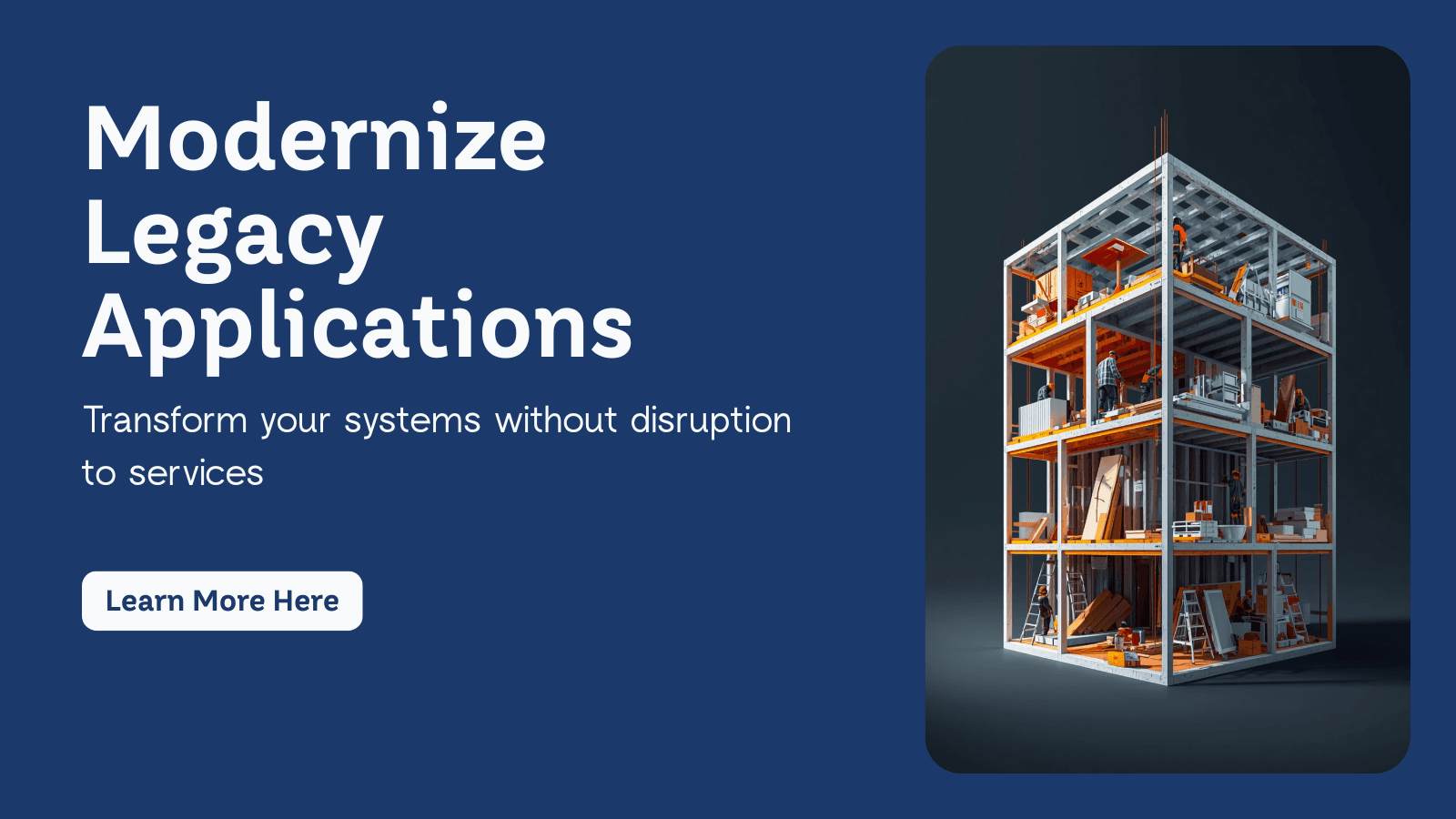
How to Modernize a Legacy Application Without Stopping Everything
By Rusty Davis
Big-bang rewrites fail more often than they succeed. Incremental modernization, done right, lets you retire legacy systems in phases without halting the business. Here's the actual methodology, including how to pick your starting point and sequence a 3-6 month sprint.
How to Modernize a Legacy Application Without Stopping Everything
Watch the short, then subscribe on YouTube.
Every CTO knows they need to modernize legacy systems. The question is not if, but how to do it without disrupting business operations.
The common answer is a complete rewrite. Build a new system, switch over, and retire the old one. Clean break, right? Unfortunately, this approach is often misguided.
In this post, I will outline the actual methodology for incremental legacy modernization. We will discuss how it works, how to sequence it, and how to identify the right starting point. This is the real framework that organizations trust us with, based on their confidence in our understanding of these processes.
Why Big-Bang Rewrites Fail
The instinct to rewrite is understandable. Legacy systems can be frustrating, while a new project feels fresh and promising. However, the idea of "doing it right this time" often overlooks the value embedded in the existing system.
Legacy systems tend to be older than they appear. Even if the code is flawed, it embodies years of edge cases that have been navigated, usually without documentation. The accounts-payable system may seem chaotic, but it encapsulates every exception the finance team has dealt with over the years. This knowledge is buried in the code.
When you opt for a rewrite, you gamble on replicating that behavior based on incomplete documentation and stakeholder interviews. More often than not, you can't capture everything accurately. The new system launches, only to reveal cases the old system managed effectively. Frustration ensues, and the rewrite team ends up in crisis mode, scrambling to patch the new system’s shortcomings, essentially doing the very work they sought to avoid.
This pattern of failure has a name: the second-system effect. You replace a known issue with an unknown one, leading to a challenging transition.
Incremental modernization helps you avoid most of these pitfalls.
The Core Principle: Reduce Surface Area Without Stopping Flow
Incremental modernization isn't about running a new system alongside the old one. It involves systematically extracting components from the legacy system, improving them, and keeping everything else operational. The goal is to gradually eliminate the old system without disrupting the business.
A legacy system isn't a single entity; it's a collection of behaviors. These can be extracted, enhanced, and redeployed piece by piece.
Key Concepts:
The Strangler Fig Pattern: Named after the strangler fig tree, which grows around an existing tree and eventually replaces it. You build new implementations alongside the old ones, routing traffic to the new system incrementally until the old one is phased out completely.
Bounded Contexts: These are portions of the system with clear interfaces. A bounded context allows you to isolate your work. Identify a bounded context, understand its behavior, replace it with a better implementation, and reconnect it without affecting the rest of the system.
How to Identify the Best Place to Start
Not all parts of a legacy system are equally viable starting points. Choosing poorly leads to high effort with minimal returns, while making the right choice enables quick wins.
Criteria for a good first bounded context:
- High incident rate: this area consumes disproportionate time in fixes.
- Meaningful isolation: changes in this area are unlikely to trigger issues elsewhere.
- Clear interface: inputs and outputs are well-defined.
- High business value: modernizing this area unlocks significant benefits.
- Manageable scope: can be completed in 6-10 weeks.
Avoid these anti-criteria:
- Deeply embedded in the data model: extraction may require schema changes.
- Tightly coupled to many other parts: too large a blast radius.
- Too broad: if it can't be described in a single sentence, it may need to be broken down.
Evaluate your candidates against these criteria to find a clear starting point. If in doubt, opt for the area with the highest incident rate to reduce operational pain and build team confidence.
A 3-6 Month Incremental Sprint: Sequencing It
Weeks 1-3: Discovery and Mapping
Before making any code changes, get a clear understanding of the system. This phase should produce:
- An architectural map of components, integration points, and data flows.
- A dependency graph illustrating how pieces connect.
- An incident history analysis showing pain points over the last year.
- A catalog of existing or potential boundaries between components.
- A prioritized list of candidate contexts for modernization.
Skipping discovery often leads to complications later on.
Output: System map, incident heat map, prioritized context list, recommended starting context.
Weeks 4-6: First Context Extraction: Design and Scaffolding
With the starting context identified, design the new implementation:
- Define the interface contract: inputs, outputs, SLAs.
- Design the new implementation: technology choices, data model, deployment architecture.
- Set up routing infrastructure to run old and new systems in parallel.
- Write a test harness to ensure the new implementation matches old behaviors.
This routing layer is crucial; it enables you to send a small percentage of traffic to the new implementation while the old one continues to operate.
Output: Interface contract, new implementation design, routing infrastructure, and functioning test harness.
Weeks 7-11: Build and Validate
Develop the new implementation and run it in parallel with the old system. Use the test harness to compare outputs, shadowing traffic to identify behavioral differences before they escalate into incidents. Document any undocumented behaviors you discover.
Gradually increase the traffic percentage to the new system as your confidence grows.
Output: New implementation live and handling production traffic.
Weeks 12-16: Cutover, Decommission, and Document
Confirm the new implementation can handle 100% of the load. Monitor it for a burn-in period of at least one to two weeks before decommissioning the old implementation.
Document your work not only regarding technical architecture but also the decisions made and edge cases encountered.
Then, reevaluate to select the next target for modernization.
Output: Target context fully migrated, decommissioned, documented, and the next context selected.
What Success Looks Like at Each Phase
After Discovery: You will have a clearer understanding of the system, boosting team confidence.
After first context migration: Reduced incident rates and increased developer confidence.
After subsequent contexts: A cumulative reduction in operational burdens and improved engineering velocity.
At program completion: The legacy system is either retired or minimized, with a team that fully understands what they’ve built.
Checklist: Is Your Team Ready for an Incremental Modernization Sprint?
- [ ] Do you have an accurate architectural diagram of the current system?
- [ ] Have you identified your highest-pain, most-isolated bounded context?
- [ ] Do you have routing infrastructure or a plan for one (API gateway, feature flags)?
- [ ] Is there test coverage, or a plan to add it before migrating?
- [ ] Do you have stakeholder alignment on the approach?
- [ ] Is there engineering capacity to run this alongside maintenance?
- [ ] Do you have a clear definition of "done" for the first context?
If you can check all of these boxes, you are ready to start. If not, consider spending a sprint on discovery and preparation to avoid future pain.
How Psolvely Runs These Sprints
Psolvely's modernization sprint is a 3-6 month engagement that guides you from discovery through the first one or two context migrations, complete with documented architecture and a roadmap for future phases. We partner with your engineering team rather than replace it, aiming to enhance your team’s capabilities: better documentation, increased confidence, and a proven methodology for ongoing modernization.
If you know you need to modernize but are unsure where to start or have encountered obstacles, let's discuss what a sprint could look like for your situation.
Want to work together?
Book a 45-minute strategy session and leave with a concrete plan.
Book a Strategy Session
Get the FREE Legacy Modernization Playbook
Ask me anything about modernizing your system and I'll personally reply — your playbook lands in your inbox the moment you hit send.