Deferring legacy modernization looks rational on paper — the risk is real, the cost is visible, and the system technically still works. But every quarter you defer, the actual cost compounds in ways that never show up on a single line item. Here's how to see the full picture.
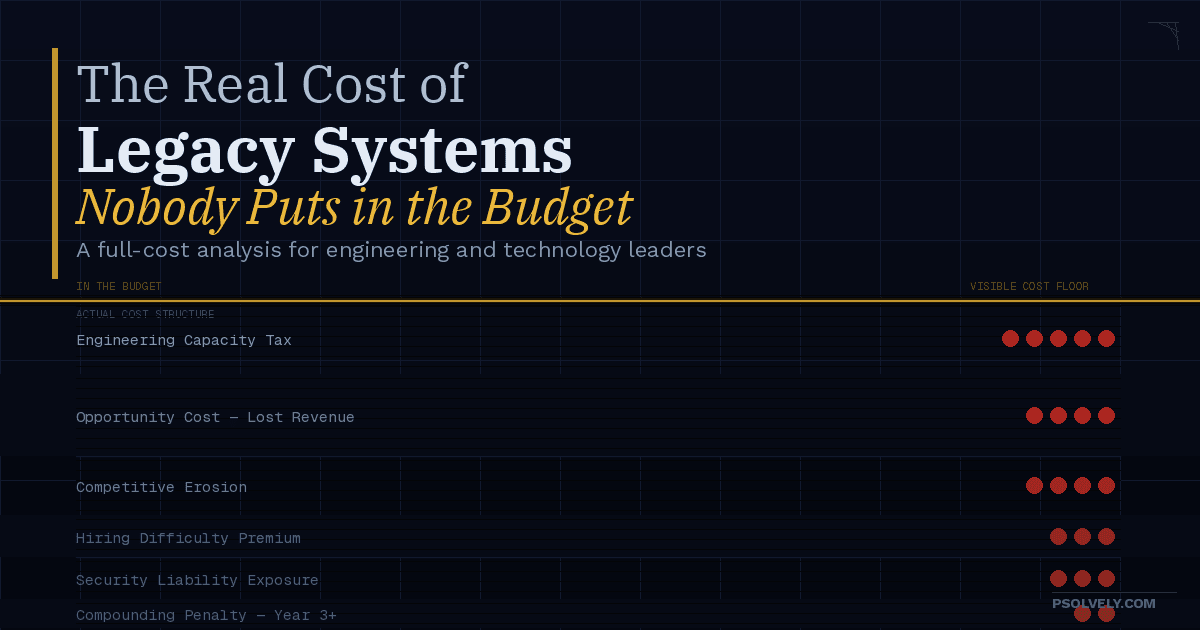
The Real Cost of Legacy Systems Nobody Puts in the Budget
Let me start by saying the quiet part out loud: deferring modernization is not irrational.
If you're a CTO or engineering leader who has pushed the legacy rewrite to next year, or the year after that, or indefinitely, I'm not here to tell you that you're wrong for doing it. You're weighing a known, manageable cost (keeping the old system running) against an unknown, highly variable cost (the rewrite or major upgrade). Your system works. Not beautifully, but it works.
That logic is sound. And it's exactly how organizations end up in serious trouble.
The deferral math looks clean year one. By year three, it's compounding in ways that never show up on a single line item. By year five, you're not just paying for the legacy system, you're paying a tax on almost everything your engineering team does.
Why the Real Cost Is Hard to See
Legacy maintenance costs are distributed and indirect. Nobody sends you an invoice that says "your old architecture cost you $840,000 this year." Instead, the cost hides in:
- Engineering time that disappears into maintenance with no feature output
- Hiring cycles that run longer because candidates don't want to work on the stack
- Security incidents and the remediation that follows
- Slow feature velocity that costs you deals
- On-call burnout that churns your best engineers
- Technical debt that makes every new feature more expensive than the last
None of these show up cleanly. They bleed into other line items. That's why the "it still works" argument wins budget conversations year after year.
Direct Maintenance Cost: The Floor, Not the Ceiling
For most organizations running legacy systems, direct maintenance absorbs somewhere between 60-80% of engineering capacity. This is time spent keeping aging infrastructure running, maintaining compatibility with deprecated APIs, debugging production issues that require archaeology, and writing workarounds for known bugs nobody has time to fix properly.
A rough benchmark: if you have a 10-person engineering team and legacy maintenance is consuming 70% of their capacity, you're paying for 10 engineers but getting feature output from 3. At $175K average fully loaded cost per engineer, that's roughly $1.2M in engineering payroll producing $375K worth of forward momentum.
That's the floor. The visible cost. Now add everything else.
Opportunity Cost: The Revenue You Didn't Build
Slow feature velocity has a direct revenue cost, and it's usually the biggest number in the analysis, but almost nobody calculates it.
Think about the last two or three features your team wanted to ship but didn't because the existing system made them too expensive. A new integration your enterprise customers were asking for. A performance improvement that kept showing up in sales objections. A workflow your team estimated at two weeks that actually took eight because of how deeply it touched the legacy core.
That's not just an engineering problem. That's a sales problem, a retention problem, and a competitive problem.
If your average enterprise contract is $80K ARR and you lost or delayed three deals last year because a competitor shipped a feature you couldn't, that's $240K in opportunity cost from a single category. The honest question to ask: What would your team have shipped if the system wasn't in the way, and what would that have been worth?
Competitive Disadvantage: The Slow Erosion You Don't See Until It's Obvious
Your competitors on modern stacks are shipping faster. Not because their engineers are better. It's because the architecture isn't fighting them.
Feature velocity on modern, well-architected systems is not marginally faster than legacy velocity. It's dramatically faster. Teams on modern stacks deploy multiple times per week. Teams on legacy monoliths with tangled dependencies might deploy once a sprint, and each deployment is a risk event.
Over time, that gap in shipping speed shows up in product capability. And product capability shows up in win rates, retention, and category position.
The insidious thing about competitive erosion is that it's gradual. You lose a few deals. Then a few more. Then a competitor announces a feature set you've been meaning to build for two years. By the time the pattern is obvious to your board, you're already 18 months behind.
Hiring Difficulty: A Real and Growing Cost
Engineers know the difference between a modern stack and a legacy one. Job postings for 15-year-old monoliths don't attract the same candidate pool as postings for cloud-native architectures. And the candidates you do attract often command a premium for tolerating the environment.
The recruiting cost of a legacy stack shows up in:
- The talent gap in engineers willing to accept the role vs the engineers who don't even look at the role
- Longer time-to-fill on engineering roles
- Higher agency fees when you can't fill roles organically
- Lower offer acceptance rates when candidates compare you to competitors on modern stacks
- Faster churn as engineers leave for more professionally stimulating roles
A single failed senior engineering hire, accounting for recruiting fees, lost productivity during the vacancy, onboarding time, and ramp period, typically costs $50K-$150K. Run two or three of those per year, and you've got a significant cost line attributable in part to your legacy stack.
Security Exposure: The Risk You're Carrying Right Now
Legacy systems accumulate CVEs (Common Vulnerabilities & Exposures). Dependencies go unmaintained. Vendors end-of-life operating systems and frameworks. At some point, you're running software that no longer receives security patches.
The average cost of a data breach for a mid-size company is roughly $4-8M, depending on the industry and the data involved. For regulated industries (healthcare, finance, legal), add regulatory penalties on top. Beyond the direct financial cost, there's an erosion of customer trust.
Even if you've never had a breach, the cost of carrying the risk is real. You're self-insuring against an exposure that grows as your stack ages.
The Compounding Effect: Why This Gets Worse Every Year You Wait
These costs don't add linearly. They compound.
The longer you defer modernization:
- Technical debt grows faster than you can pay it down through maintenance
- The gap between your stack and the current ecosystem widens, making the eventual migration more expensive
- Institutional knowledge is concentrated in fewer people, and those people eventually leave
- Your competitive gap widens as faster competitors gain ground
- Security exposure grows as more components age out of support
A modernization engagement that costs $300K today might cost $600K in three years, not because the market got more expensive, but because the system got harder to work with.
A Cost-Estimation Framework
Apply this to your own situation:
1. Engineering Capacity Tax
(Maintenance FTE count × fully-loaded annual cost) × % time on legacy maintenance
2. Opportunity Cost
(Deals lost or delayed attributable to velocity) × average ACV
Plus: delayed roadmap items × estimated revenue impact
3. Hiring Premium
(Extended time-to-fill in months × open role cost per month) + failed hire cost × annual turnover
4. Security Liability Look at your CVE exposure, compliance requirements, and cyber insurance premiums.
5. Compounding Penalty Add 15-25% per year to each of the above if you defer.
Add these up for a 3-year projection. Then compare that number to the cost of an incremental modernization engagement.
Why Incremental Modernization Beats Both Alternatives
Full rewrites fail more often than they succeed. The engineering literature is consistent on this. But inaction has the costs we just walked through.
The middle path is incremental modernization. Strangling the legacy system systematically, module by module, while keeping production stable. This approach keeps the existing system running, reduces risk by keeping each change scope small, and starts delivering engineering capacity improvements faster than a full rewrite would.
At Psolvely, this is what we do. We work with engineering teams to scope and execute targeted modernization. This is not a five-year program, not a risky rewrite, but strategic, bounded engagements that move the needle on the metrics that matter: deployment frequency, maintenance burden, hiring signal, and security posture.
If you're running the math for the first time, we should talk.
Want to work together?
Book a 45-minute strategy session and leave with a concrete plan.
Book a Strategy Session
Get the FREE Legacy Modernization Playbook
Ask me anything about modernizing your system and I'll personally reply — your playbook lands in your inbox the moment you hit send.