The engineer who built your legacy system left three weeks ago. Now your team maintains code nobody fully understands, and every change feels like defusing a bomb. Here's how teams end up in this situation, what it's actually costing you, and how to start getting out.
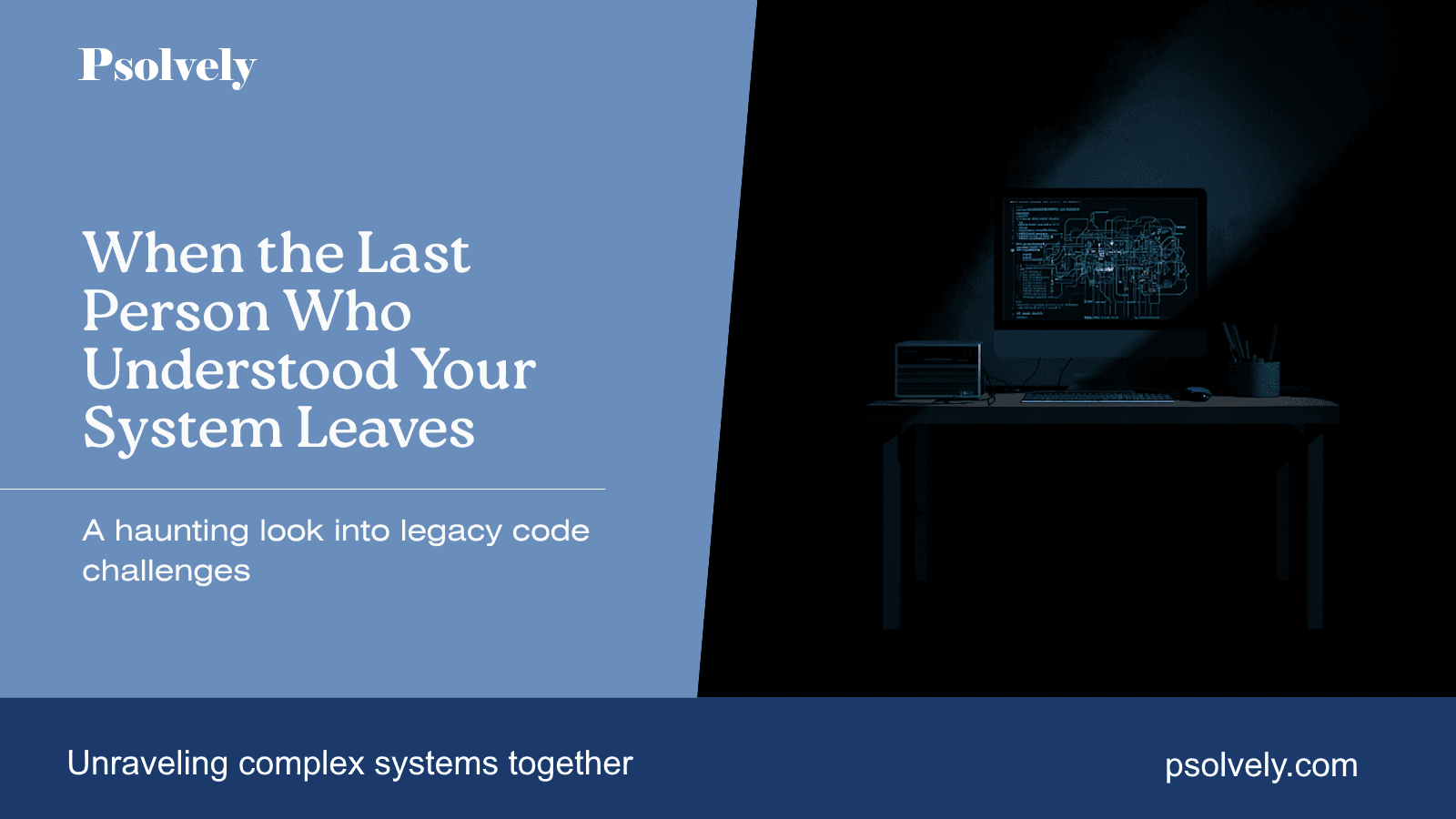
When the Last Person Who Understood Your System Leaves
The last engineer who truly understood this codebase left three weeks ago. Maybe they retired. Maybe they got recruited away. Maybe they left on bad terms and took three years of tribal knowledge with them.
Either way, your team is maintaining something they didn't build, don't fully understand, and are afraid to touch.
That's not a reflection on your team. That's the legacy trap. It's one of the most common and least talked-about problems in enterprise software.
Here's what's really happening and what it's costing you.
How Teams End Up Here
Legacy systems don't become a mystery overnight. They get there through a series of reasonable decisions made over many years.
A system gets built. It works. The team that built it moves on. New engineers join, learn just enough to handle their piece of it, and avoid anything that feels risky. Documentation gets stale because nobody has time to update it. The engineers who could have updated it are already gone.
Meanwhile, the system keeps running. It gets patched. Workarounds get added on top of workarounds. A critical integration gets bolted on during a crunch, and nobody goes back to clean it up. A performance issue gets "fixed" with a hack that ends up being load-bearing. Nobody documents it because it was supposed to be temporary.
Five years later, every change is a small act of faith.
The engineers maintaining it now are good engineers. They're not incapable. They're working with incomplete information in a high-stakes environment, and they know it. That produces something specific: a team so careful they're almost paralyzed. Every deployment feels like it might break something nobody knows how to fix.
What Maintaining an Opaque System Actually Costs
The obvious costs are easy to spot. Incidents take longer to resolve because figuring out the root cause means reading through layers of code written by people who are no longer there. New features take longer to ship because every change requires understanding what else might break, and that's not documented anywhere.
The less obvious costs are bigger.
Opportunity cost. Your engineers are spending real time maintaining something instead of building something. Every hour spent digging through legacy code is an hour not spent on what the business actually needs. At scale, that's a huge drag on your ability to move.
Retention risk. Talented engineers leave systems they can't understand and can't improve. Nobody wants to spend their career afraid of what they're responsible for. The ones who stay the longest get comfortable with the fear, and that's not always who you want to keep. When your best people leave, they take whatever they learned with them. The cycle continues.
Growing uncertainty. Every change made without fully understanding the system makes it slightly harder to understand the next time. The team fixes the bug but can't be sure they didn't introduce a new one. The uncertainty adds up. The system gets harder to work with over time, not easier.
Business risk. At some point the system runs out of runway. A dependency goes end-of-life. A vendor drops support. A compliance requirement can't be met with the current architecture. Now you're doing a forced migration under time pressure. That's the worst possible way to make architectural decisions.
This is how "it still works" becomes "we're in crisis."
Why New Hires Can't Save You
A common response to the knowledge problem is to hire your way out of it. Bring in fresh engineers, get new eyes on the codebase.
This rarely works for a few reasons.
First, getting up to speed on a complex legacy system takes time, often a year or more. While new hires are learning, they're a drain on the team's existing capacity. They need help from engineers who are already stretched thin.
Second, new engineers often find the system just as confusing as the engineers who've been there for years. The problem isn't that the current team isn't smart enough. The problem is the system genuinely can't be understood from the code alone. Key decisions were made verbally, in meetings that weren't documented, by people who are gone. No amount of intelligence recovers that from a code review.
Third, new hires quickly pick up how the existing team operates. They learn what's safe to touch and what isn't. Within six months, they're doing the same careful dance everyone else is doing.
You haven't added clarity. You've added more people working in the same fog.
How the Problem Gets Worse
Every quarter that passes without a real effort to understand and document the system is a quarter where the gap between what the system does and what the team understands can only stay the same or grow. It almost never shrinks on its own.
Team turnover makes it worse. Every engineer who leaves takes their knowledge with them, and the replacement starts from a lower baseline. After five or six years of normal turnover, nobody on the current team was around for any of the original design decisions.
Patches and workarounds make it worse. Every change made without fully understanding the system adds a dependency that wasn't anticipated.
Left alone, this ends one of three ways: a forced crisis migration, a slow business decline because the organization can't move fast enough, or an expensive emergency when something finally breaks badly enough to force action.
What a Knowledge Recovery and Incremental Modernization Engagement Looks Like
There's a way out, but it's not a full rewrite and it's not hiring more people to inherit the same mess. It's a structured process focused first on understanding what you have, then on modernizing it piece by piece to reduce risk over time.
Phase 1: Discovery and Documentation
The first phase is about making the system understandable. That means going through the codebase, the integration points, the data flows, and the deployment setup to build an accurate picture of what's there. It means talking to everyone on the team to get the knowledge out of people's heads and into writing. It means watching the system run to understand what it actually does, not just what it was designed to do.
The output is documentation that reflects the real system: accurate diagrams, data flow maps, a list of integration points and how they fail, and a clear picture of what's well understood versus what's still a mystery.
Phase 2: Risk and Priority Mapping
Once you know what you have, you can decide what to fix first. Not every part of a legacy system is equally risky. Some parts are stable and low priority. Others are constantly changing, poorly understood, and responsible for most of your incidents. Those are your starting points.
Priority mapping finds the highest-leverage targets: the parts where modernization will produce the biggest reduction in risk and maintenance burden.
Phase 3: Incremental Modernization
With a clear picture and a priority list, you can start modernizing without stopping everything. Isolate a piece of the system, modernize it, confirm the behavior is preserved, deploy it. Then move to the next piece.
Each phase delivers something real: fewer incidents in the modernized area, more confidence from the team, better documentation. Progress you can measure.
Why an Outside Partner Helps
Knowledge recovery work is hard to do on your own. Your team is already at capacity maintaining the system. Taking engineers off maintenance to do discovery creates risk. And the people closest to the system have adapted to the confusion. It's hard to see clearly from inside it.
An outside partner who has done this kind of work before can move faster through discovery, bring structure to the mapping work, and provide the outside perspective that's hard to maintain when you're in it every day.
At Psolvely, this is exactly what we do. We come in alongside teams stuck maintaining systems they didn't build and help them get to a place where the system is understandable, the risk is mapped, and modernization is happening in steps instead of looming as a future crisis.
If your team is in this situation, maintaining something nobody fully understands, afraid to make changes, watching good engineers leave, we should talk. You're not alone in this, and there's a clear way through it.
Start at psolvely.com.
Want to work together?
Book a 45-minute strategy session and leave with a concrete plan.
Book a Strategy Session
Get the FREE Legacy Modernization Playbook
Ask me anything about modernizing your system and I'll personally reply — your playbook lands in your inbox the moment you hit send.